 Skip to content

YouTube SEO is often taught as if it were Google SEO with a thumbnail stuck on top: pick a keyword, drop it in the title, add tags, and wait.
That was already a weak way to work. Going into 2027, it is weaker still. YouTube search is only one way people find a video. A title that ranks but then gets a quick close will not travel far in Suggested or Home. You cannot read public view counts from 2025 and 2026 as if they were the same number. On 24 August 2026 YouTube began counting a public view from the first frame, and kept the older, stricter count under a new name, engaged views YouTube, What are ‘Engaged’ Views?.
I have been making YouTube videos from Pakistan since 2018. The method below is the one I use when I do not want to guess the next upload. YouTube search, a spreadsheet and Studio are usually enough. I sometimes use my own tool, TubeMind, to scan channels.
Why guessing fails as YouTube SEO, and how search actually works
On Google, a lot of searches have a clear job: learn something, compare two options, or complete a task. On YouTube the same words can mean “teach me”, “show me proof”, or “talk me through this while I watch”. If you already think in terms of search intent, YouTube adds a second layer: it is not a copy of the Google results page.
YouTube itself says search rankings are not a list of the most viewed videos for a query. Videos are ranked on how well the title, description and the video itself match the search, and on which results keep people watching YouTube Help, YouTube performance FAQ. A short, specific how to can beat a bigger channel’s vague vlog on the same words.
The failed pattern I see most often is this: pick a topic because it is trending in a WhatsApp group, write a broad title, and hope the algorithm “picks it up”. People type a problem. Your job is to be the clearest answer.
Outlier videos: use them as clues, not as the whole plan
An outlier is a video that did much better than that same channel usually does. It is a clue that a topic or title found an audience, not a template you should copy shot for shot. A simple way to spot one, using only public pages: open a channel in your niche, go to the Videos tab, sort by Popular, and compare the top long form
videos with recent uploads. If one sits well above the usual level, write down the title, the length, and the format.
Keep Shorts and long form apart. If you compare a video from before 24 August 2026 with one from after, the public view counts are not in the same unit. An outlier tells you what worked then. Search predictions tell you what people are still typing today.
Keyword research with YouTube search predictions
I treat YouTube keyword research more like listening than like a volume spreadsheet.
Type the core phrase into YouTube search and read the predictions before you press Enter. YouTube says those suggestions come from what other people have searched for. They can be shaped by your own history, so use a clean browser profile when you can.
Then search the same phrase on Google. Those results show whether people want a written answer or a tool. The YouTube results show whether they want a screen recording or a face talking them through the problem. This is the same intent check you already use for SEO copy, on a different page.
A few patterns I keep seeing for Pakistani how to searches.
- Place names and constraints show up in the query itself: “in Pakistan”, “without VPN”, “without OTP”, “in rupees”.
- The winning video often answers the exact constraint in the title, not in a clever line that hides the topic.
- A Google style “ultimate guide” title can lose to a plain title that sounds like the search.
You do not need a third party volume number to make the call. If YouTube offers several close predictions, and the existing videos leave a gap, you have enough to brief a video.
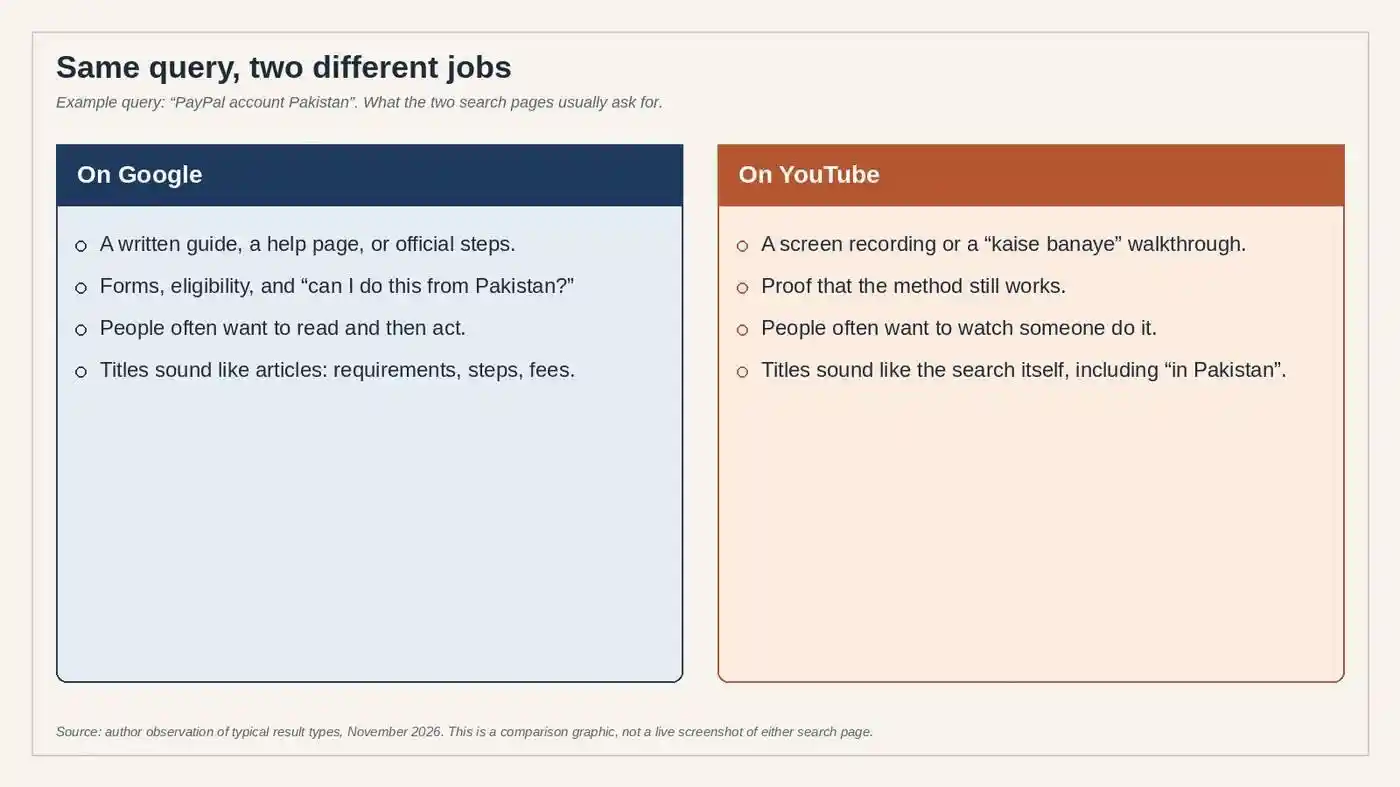
Side by side comparison graphic. Left: Google search intent for a query such as “PayPal account Pakistan” (forms, official steps, written guides). Right: YouTube search intent for the same query (screen recordings, “kaise banaye” walkthroughs, proof videos). Source: author, November 2026.
Competitor and niche gaps, step by step
Once you have a phrase, open the first page of YouTube results and make a short grid.
- Which titles repeat the query near the front?
- Which videos are more than 18 months old, or still say 2024 or 2025 in the title?
- Which ones are from channels much larger than yours, and which are from channels closer to your size?
- What do the comments ask that the video did not answer?
The gap is usually not “no one made this”. It is “no one made a clear, current version for this audience”, including methods that no longer work in Pakistan.
I ran the example below on a signed in account, so treat the suggestion list as a sample, not a clean profile list. On 20 November 2026, at 12:40 PM PKT, “paypal account pakistan” showed 14 suggestions, including year, language and “without uk sim” variants.
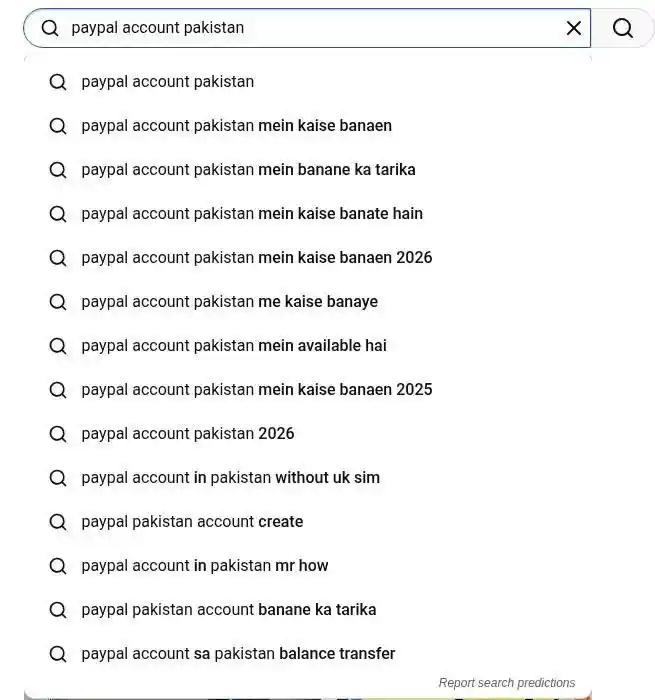
YouTube search predictions for “paypal account pakistan”, captured 20 November 2026, 12:40 PM PKT, on a signed in YouTube account. Fourteen suggestions are shown, including “paypal account pakistan mein kaise banaen 2026”, “paypal account pakistan 2026”, and “paypal account in pakistan without uk sim”. Source: YouTube searc
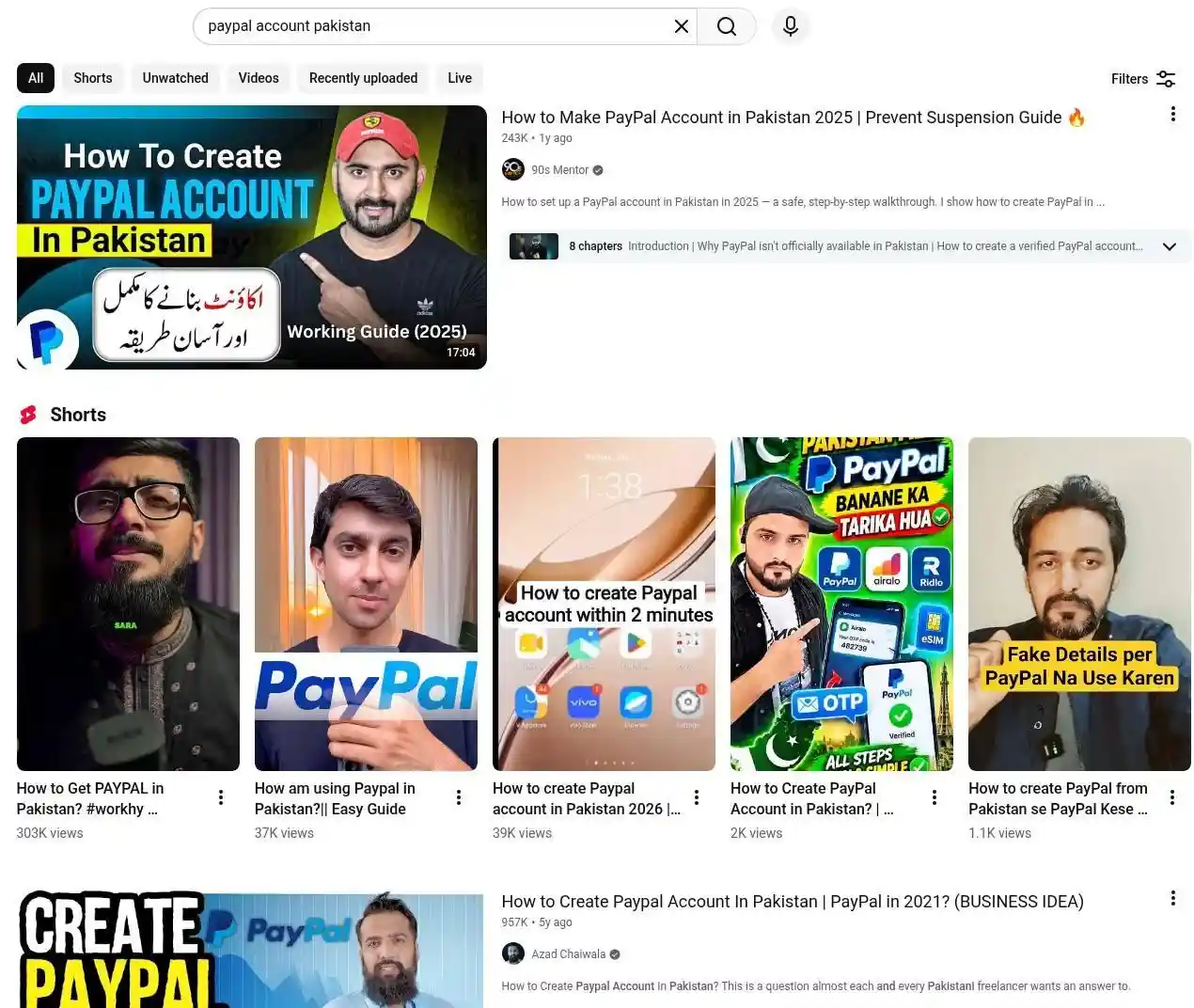
First page of YouTube results for “paypal account pakistan”, captured 20 November 2026, 12:41 PM PKT. The top result is “How to Make PayPal Account in Pakistan 2025 | Prevent Suspension Guide”, showing 243K views and “1 year ago”, from the channel 90s Mentor. Source: YouTube search.
The results page is a simple example of a gap: people are still searching this in late 2026, and the first result still has 2025 in the title.
If you already do this kind of gap work for new websites and long tail keywords, the YouTube version is the same habit with two extra columns: length, and whether the thumbnail matches the title.
Turning the data into titles, thumbnails and hooks
YouTube’s own guidance is plain. Put the important words early. Make the title accurate. Keep the thumbnail readable on a phone. Do not use a title or thumbnail that misleads, or that relies on shouting in caps (YouTube Help, performance FAQ).
For search traffic, I write the title as if it were the searcher’s own sentence, then I tighten it. “How to create a PayPal account in Pakistan” is easier to match than “The payment setup no one talks about”. For Home and Suggested you can add a little more tension, but the video still has to keep the same promise.
The hook, the first 15 to 30 seconds, should confirm the promise. If the title says you will show a method, show the method. If the open does not match the packaging, people leave.
Tags are not the job. YouTube has said for years that tags play a minimal role in discovery and are mainly useful for common misspellings. Spend that time on the title and thumbnail, then the first line of the description, which often shows under the title in search.
Lessons from my own channel
I can only be precise about public pages I have checked myself, so these examples come from my own channel. On 20 November 2026, at 12:42 PM PKT, the public watch page for “How to Use telegram without VPN in Pakistan | Telegram connecting Problem solved” showed 480K views, and said the video was published two years earlier. The same day, my channel’s Popular tab showed “He Earned 12 Millions from Binance Crypto Trading in Pakistan | Podcast with Tanveer of @P4Provider” at 517K views, also two years earlier. Other visible counts on that grid were 282K, 245K and 207K. The Telegram title reads like a search a Pakistani viewer would type. The podcast is a different format: a name, a claim and a conversation, which can travel through Suggested rather than a how to query. The videos on my channel that still get found years later usually name the problem in the title, in the language people actually use, including “in Pakistan” when that is the constraint.
I cannot see another creator’s Studio data, so I will not invent a second case study. Pick two channels in your niche, sort by Popular, compare searchable titles with vague ones, and note the date.
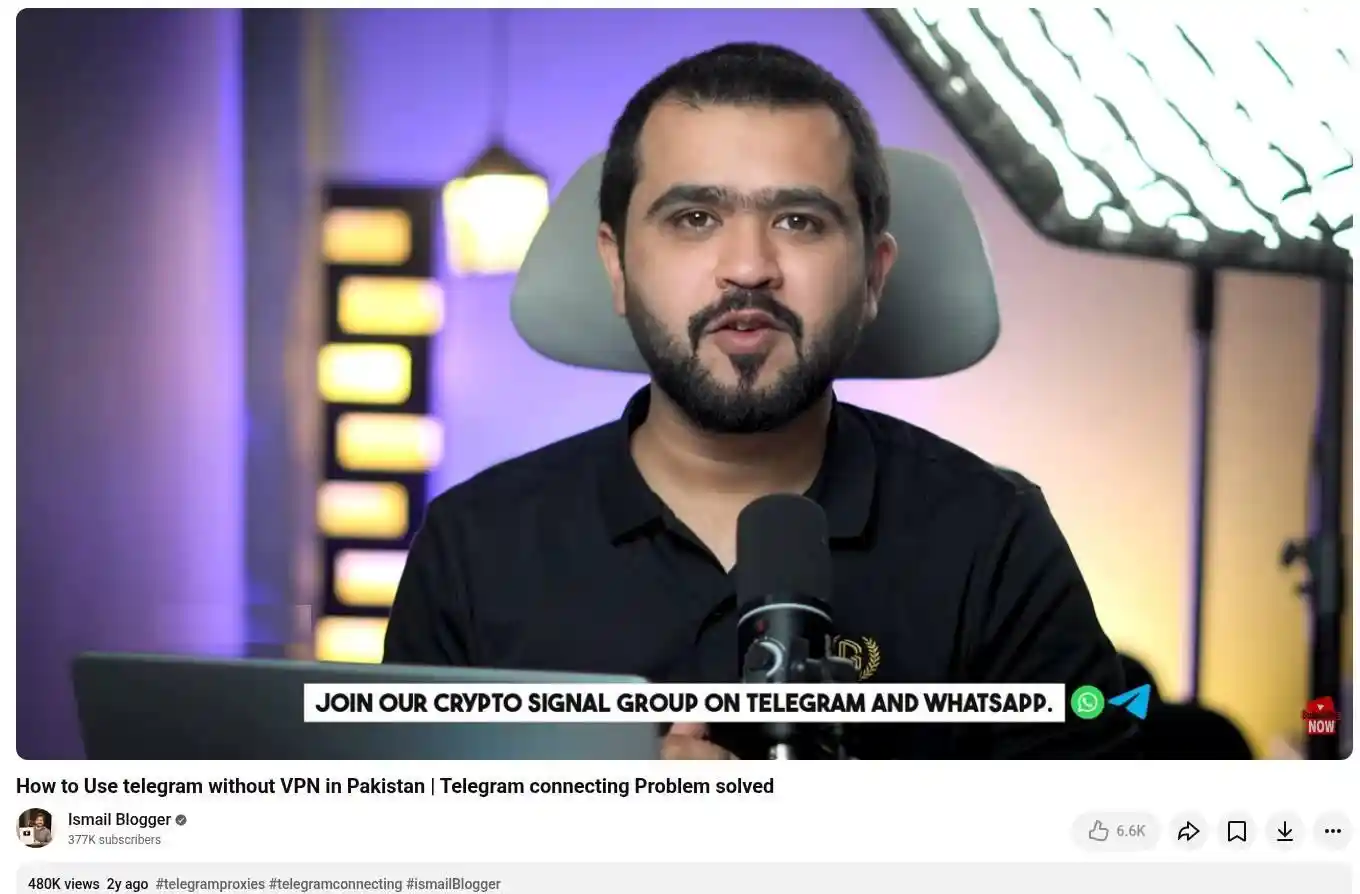
Public watch page of “How to Use telegram without VPN in Pakistan | Telegram connecting Problem solved”, captured 20 November 2026, 12:42 PM PKT. The page shows 480K views and “2y ago”. Source: YouTube.
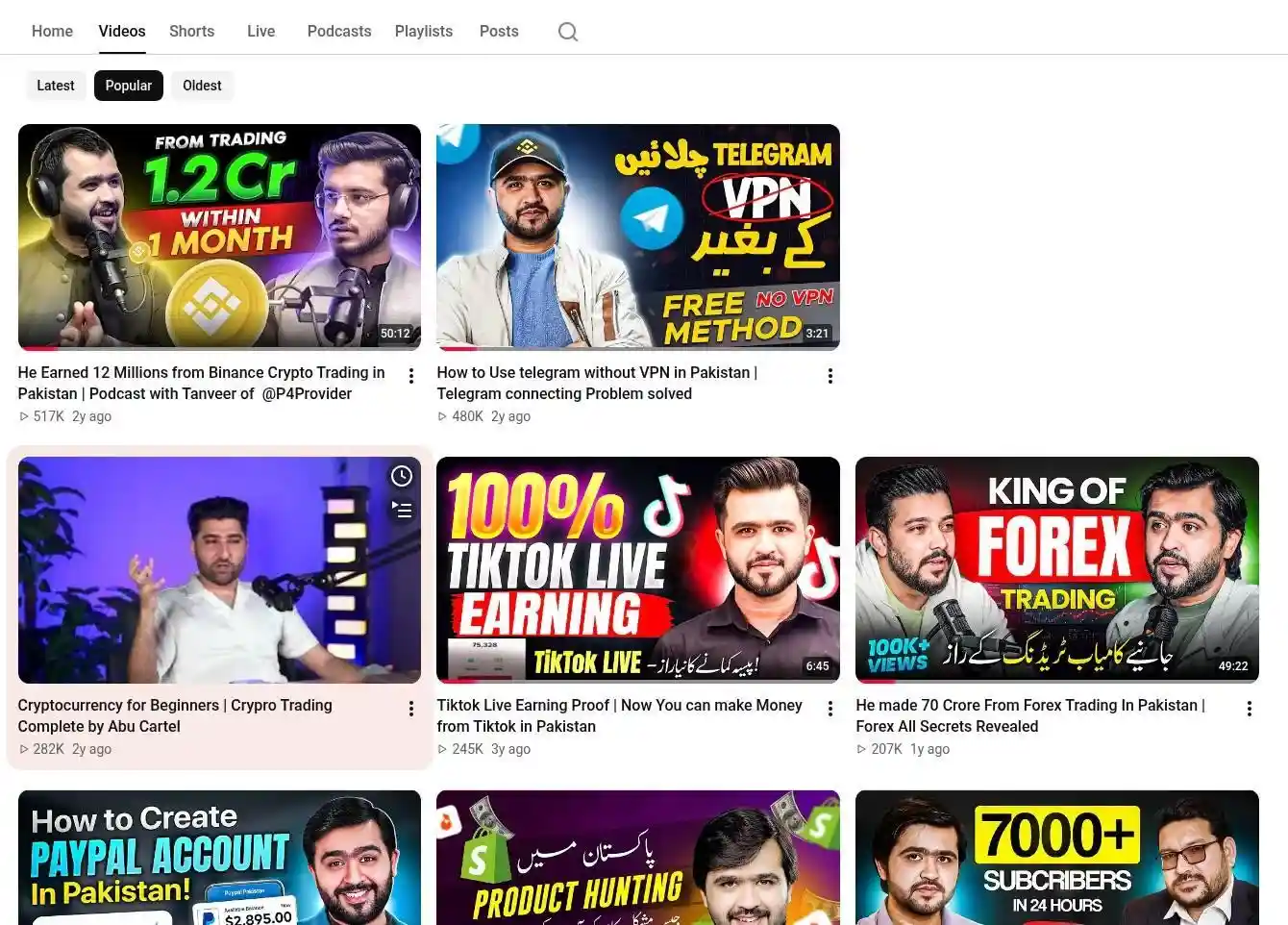
The Videos tab of youtube.com/@Ismailvlogger, sorted by Popular, captured 20 November 2026, 12:42 PM PKT. Visible view counts include 517K, 480K, 282K, 245K and 207K. One card was removed from this figure because its title was not suitable to publish. Source: YouTube.
A YouTube SEO checklist before you film
Before you film, you should be able to tick these off.
- You can write the viewer’s search in one plain sentence.
- YouTube search predictions support that sentence, or you have a clear reason to make it anyway.
- You have checked the current YouTube results and can say what is outdated or missing for a Pakistani viewer.
- The title leads with the query, and the thumbnail does not fight it.
- The first 30 seconds deliver the promise.
- If you use another video as a benchmark, you know its publish date and you are not mixing public views from before August 2026 with newer ones.
If you would like a second pair of eyes on a title or a brief, send them over and I will say what I would change.
About the author
Muhammad Ismail is a Pakistani creator on YouTube (@Ismailvlogger) and the founder of TubeMind (tubemind.io), a YouTube research tool. He has been publishing online since 2010, has taught more than 33,000 learners on Udemy, and spoke at TEDxFAST Peshawar.
