 Skip to content
Why Most Google Ads Fail
You launch a Google Ads campaign. Day one looks promising. By week two, clicks drop. Conversions slow down. Your cost per click creeps higher. By month three, you’re burning money with little to show for it.
Sound familiar?
This isn’t random bad luck. Most Google Ads campaigns fail for one simple reason: they lack a proper optimization loop.
Here’s the thing. Too many advertisers treat Google Ads like a vending machine. They put money in, expect results out, and forget about it. They create ads, set a budget, hit launch, and then… nothing. No monitoring. No adjustments. No learning.
This “set and forget” mindset is exactly why ads fail. Google Ads isn’t a one-time setup. It’s a living system that needs constant attention, data analysis, and smart decision-making.
The good news? There’s a proven framework that separates winning campaigns from money pits. It’s called the Google Ad Optimization Loop, and understanding it can completely transform your advertising results.
In this guide, you’ll learn exactly what this loop is, why your ads fail without it, and how to build one that actually drives profits.
What Is the Google Ad Optimization Loop?
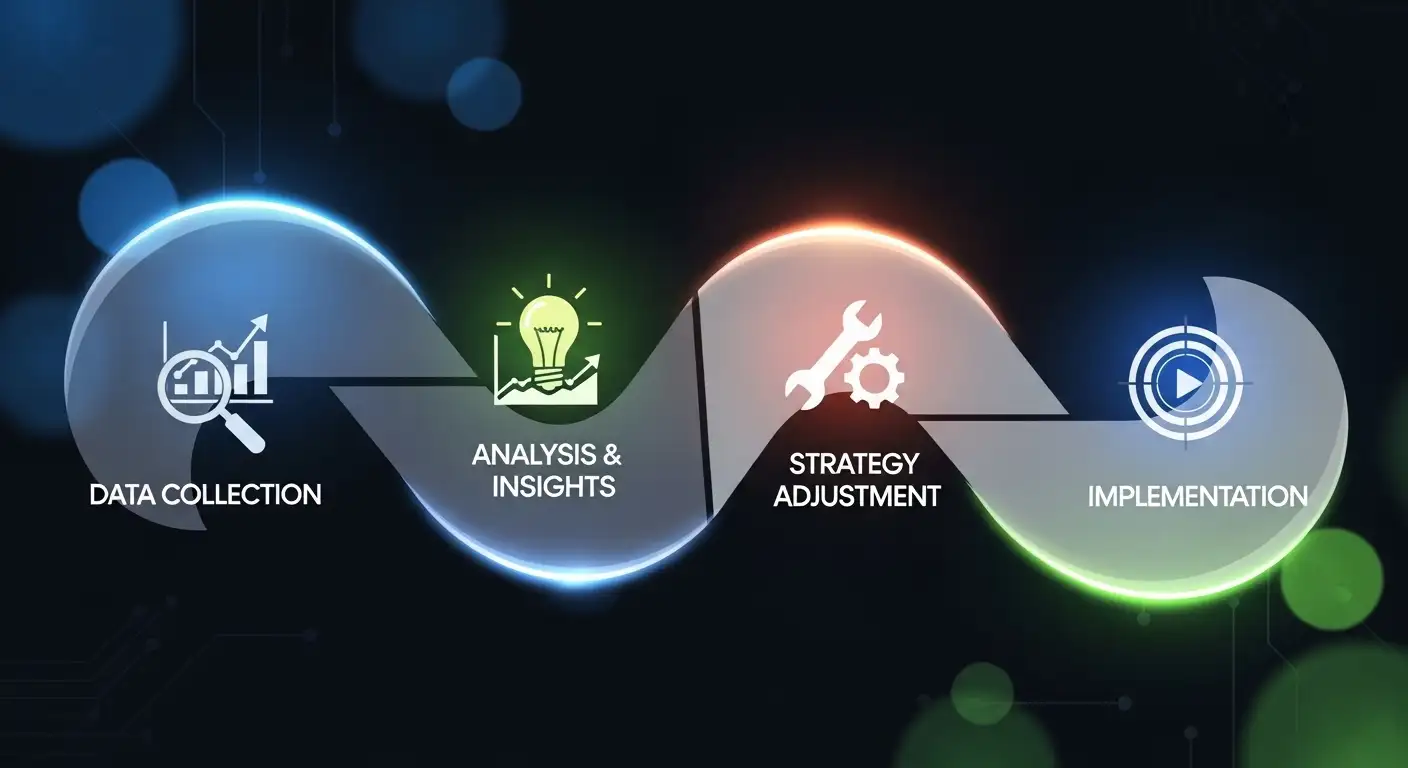
Think of the Google Ad Optimization Loop as a continuous cycle of improvement. It’s not a one-time fix. It’s an ongoing process where you collect data, analyze what’s working, make informed changes, let Google’s algorithm learn, and then repeat.
Here’s the simple version:
• You run ads and collect performance data
• You analyze that data to find patterns and problems
• You make optimization changes based on insights
• Google’s algorithm learns from these changes
• You measure the impact and start the cycle again
The keyword here is “continuous.” The optimization loop never stops. Your market changes. Competitors adjust their strategies. User behavior shifts. Costs fluctuate. A campaign that works today might underperform next month without ongoing optimization.
This loop connects three critical elements: your ads (what people see), your data (what’s actually happening), and your decisions (what you do about it). When these three work together in a structured cycle, your campaigns improve over time instead of declining.
Why Ads Fail Without an Optimization Loop
Running Google Ads without an optimization loop is like driving with your eyes closed. You might move forward for a bit, but you’ll crash eventually.
Here’s exactly what happens when the loop is broken:
No Feedback Mechanism
Without regular data review, you have no idea what’s working. You might be spending 80% of your budget on keywords that never convert. Your best-performing ads might be getting only 5% of impressions. Bad placements could be draining your account while quality traffic gets ignored.
You’re flying blind. And blind advertisers waste money.
Poor Data Utilization
Google Ads generates mountains of data every single day. Click-through rates, conversion rates, quality scores, search terms, device performance, time of day patterns, and audience demographics. This data is gold, but only if you actually use it.
Most advertisers collect this data but never analyze it. It just sits there. Meanwhile, competitors who do analyze their data are making smarter decisions, lowering their costs, and stealing your potential customers.
Rising CPC and Declining ROI
Here’s what typically happens: You launch a campaign. Initial results are decent. But as time passes, your cost per click increases while your return on investment decreases.
Why? Because without optimization, your quality score drops. Google rewards advertisers who continuously improve their campaigns with lower costs and better ad positions. When you don’t optimize, Google assumes your ads aren’t relevant, increases your costs, and shows your ads less frequently.
The competition also keeps optimizing. So even if you stand still, you’re actually falling behind.
Want to see how an optimization loop can turn your campaigns around? Check out my case studies where I’ve helped businesses cut costs by 40% while doubling conversions.
Key Components of the Google Ad Optimization Loop
Now that you understand why the optimization loop matters, let’s break down its five core components. Each one plays a specific role in keeping your campaigns profitable and improving over time.
Data Collection
Everything starts with data. Google Ads tracks hundreds of metrics, but you need to focus on the ones that actually matter for your business goals.
The essential metrics include:
• Conversion rate: How many clicks turn into actual customers or leads
• Cost per conversion: How much you’re paying for each sale or lead
• Click-through rate: How often people click your ads when they see them
• Quality Score: Google’s rating of your ad relevance and landing page experience
• Search terms: The actual phrases people type before clicking your ads
Make sure conversion tracking is properly set up. Without accurate conversion data, you’re just guessing which changes work. Set up Google Analytics 4, enable conversion tracking in Google Ads, and verify everything is firing correctly.
Analysis and Insights
Raw data means nothing without analysis. This is where you spot patterns, identify problems, and find opportunities.
Ask yourself these questions:
• Which keywords drive actual conversions versus just clicks?
• What time of day or day of week performs best?
• Are mobile users converting as well as desktop users?
• Which ad copy variations get the most engagement?
• What search terms are wasting budget?
Look for the big gaps. Maybe you’re paying premium prices for a keyword that brings lots of clicks but zero sales. Or perhaps one specific location delivers 10x better return than others. These insights guide your next moves.
Optimization Actions
Now comes the action part. Based on your analysis, you make specific changes to improve performance.
Common optimization actions include:
• Pausing or removing underperforming keywords
• Adding negative keywords to block irrelevant searches
• Adjusting bids based on device, location, or time performance
• Testing new ad copy variations
• Refining audience targeting
• Updating landing pages for better conversion rates
The key is making changes based on data, not hunches. Every optimization should solve a specific problem you discovered in your analysis.
Algorithm Learning
Here’s something many advertisers miss: Google’s algorithm needs time to adapt to your changes.
When you make significant changes like adjusting bids, adding new keywords, or changing targeting, Google enters a learning phase. During this time, the algorithm tests different combinations to figure out how to best deliver your ads.
This learning phase typically lasts 7-14 days, depending on your campaign volume. Performance might fluctuate during this time. That’s normal. The algorithm is experimenting to find the optimal delivery strategy.
Don’t panic and revert changes too quickly. Give the system time to learn and stabilize.
Iteration and Scaling
Once you’ve made optimizations and the algorithm has learned, you measure the results and start the cycle again.
Did your changes improve performance? Great, double down on what works. Did something make things worse? Roll it back and try a different approach.
This is also when you scale winning campaigns. If you found a profitable keyword cluster, increase the budget. If a specific audience segment converts well, expand targeting to similar users. Growth happens when you identify what works and systematically do more of it.
Google’s Algorithm vs Human Optimization

There’s some confusion about what Google handles automatically and what you need to control yourself. Let’s clear this up.
What Google Handles Automatically
Google’s machine learning does a lot of heavy lifting:
• Auction bidding decisions in real-time
• Adjusting bids based on device, location, and time signals
• Predicting which users are more likely to convert
• Testing ad variations in responsive search ads
• Matching your ads to relevant search queries
These automated features work great when given the right foundation. But they can’t replace strategic thinking.
What Advertisers Must Control
You’re responsible for the strategic decisions:
• Choosing the right campaign types and goals
• Selecting keywords and match types
• Writing compelling ad copy
• Setting appropriate budgets and bid strategies
• Defining target audiences
• Adding negative keywords
• Creating high-converting landing pages
Google’s algorithm optimizes within the parameters you set. If your parameters are wrong, the algorithm will optimize for the wrong things.
Why Human Strategy Still Matters
Automation is powerful, but it’s not intelligent in the way humans are. Google’s algorithm doesn’t understand your business model, profit margins, customer lifetime value, or competitive positioning.
You know that certain customers are worth 10x more than others. You understand seasonal patterns in your industry. You recognize when a competitor launches a new campaign and need to adjust accordingly.
The optimization loop works best when you combine Google’s machine learning with human strategic thinking. Let the algorithm handle the micro-adjustments while you focus on the bigger picture decisions.
Struggling to balance automation with strategic control? Let’s talk about optimizing your campaigns with the right mix of both.
Signs Your Ads Are Stuck in a Broken Loop
How do you know if your optimization loop is broken? Here are the warning signs:
High Spend, Low Conversions
You’re burning through your daily budget quickly, getting plenty of clicks, but conversions are terrible. This screams poor targeting and a lack of optimization. You’re probably bidding on too many broad keywords, not using enough negative keywords, and not adjusting bids based on actual conversion data.
Unstable Performance
Your campaigns swing wildly from day to day. One day you get five conversions, the next day zero. This inconsistency usually means your campaigns lack structure and optimization discipline. Small sample sizes, constant changes without data backing them, or insufficient learning time all contribute to this instability.
Endless Learning Phases
Your campaigns show “Learning” status for weeks or even months. This happens when you make too many changes too frequently, or when your campaigns don’t have enough conversion volume to exit the learning phase.
Google needs about 50 conversions over 7 days to complete learning. If you’re not hitting those numbers, you might need to broaden targeting, increase budget, or consolidate campaigns to generate sufficient data.
Other red flags include declining quality scores, steadily increasing cost per click, dropping impression share, and campaigns that performed well initially but have degraded over time.
If you’re seeing these symptoms, your optimization loop needs immediate attention.
How Long the Optimization Loop Takes
Patience is critical in Google Ads. The optimization loop isn’t a quick fix. It’s a marathon, not a sprint.
Learning Phase Timelines
When you first launch a campaign or make significant changes, expect a learning phase of 7-14 days. During this time, Google is experimenting with when, where, and to whom to show your ads.
For Smart Bidding strategies like Target CPA or Target ROAS, the algorithm needs about 50 conversions in a 30-day window to optimize effectively. If your conversion volume is lower, learning takes longer.
Performance campaigns generally stabilize within 2-4 weeks, but true optimization is an ongoing process measured in months, not days.
When to Optimize vs Wait
Here’s a rough timeline for optimization actions:
• Days 1-7: Monitor daily but avoid changes. Let the algorithm learn
• Days 8-14: Review data, add negative keywords if needed, but hold off on major changes
• Days 15-30: Start making data-driven optimizations based on trends
• Month 2+: Regular optimization cycle kicks in, weekly or bi-weekly reviews
Never make changes just because you’re impatient. Every change resets parts of the learning process. Wait until you have statistically significant data before acting.
That said, some things need immediate action. If you spot obvious problems like accidentally targeting the wrong location, go ahead and fix them right away. Use judgment.
Best Practices to Build a Profitable Optimization Loop
Now let’s talk about how to actually implement an optimization loop that drives results.
Structured Testing
Don’t just throw random changes at your campaigns. Test systematically.
Only test one variable at a time. If you change your headline and your landing page simultaneously, you won’t know which one caused the performance shift.
Document every test. Create a simple spreadsheet tracking what you changed, when, and the results. This historical record becomes invaluable as you scale.
Use campaign experiments or ad variations features in Google Ads. These built-in testing tools split traffic evenly and measure results automatically.
Data Thresholds
Know when you have enough data to make decisions.
For keywords, wait until you have at least 100 clicks before pausing underperformers. For conversion-based decisions, aim for at least 20-30 conversions before drawing conclusions.
Small sample sizes lead to bad decisions. A keyword with 5 clicks and zero conversions might just be unlucky. A keyword with 200 clicks and zero conversions is clearly a problem.
Use statistical significance calculators if you’re testing ad copy or landing pages. Don’t declare a winner until you’re 95% confident the result isn’t random chance.
Budget Control
Control your spending during optimization. Set daily budgets that allow for consistent data collection without burning through cash too quickly.
As a rule of thumb, your daily budget should be at least 10x your target cost per conversion. This gives the algorithm room to operate and collect meaningful data.
Monitor your spend daily during the first two weeks. After campaigns stabilize, weekly reviews are usually sufficient unless you notice sudden changes.
Additional best practices: Keep campaign structures simple, focus on your top-performing 20% of keywords for 80% of budget, add negative keywords weekly, review search terms reports religiously, and maintain separate campaigns for different products or services.
Who Needs This Loop the Most
The Google Ad Optimization Loop benefits everyone, but some businesses need it more urgently than others.
Small Businesses
If you’re a small business with a limited marketing budget, you can’t afford to waste a single dollar. The optimization loop ensures every penny works as hard as possible. You’re competing against bigger companies with larger budgets, so your advantage comes from being smarter and more agile with your optimization.
E-commerce
E-commerce businesses running shopping campaigns or product ads deal with hundreds or thousands of SKUs. The optimization loop helps you identify which products are profitable to advertise, which need better product feed optimization, and where to allocate budget for maximum return.
Product margins vary widely in e-commerce. The loop ensures you’re spending more on high-margin products and less on low-margin ones.
Agencies and B2B
Agencies managing multiple client accounts need systematic optimization processes. You can’t manually babysit every campaign, so having a repeatable loop ensures consistent results across all clients.
B2B companies with longer sales cycles and higher-value conversions need the loop to properly track and attribute results. You might not see ROI for months, so ongoing optimization based on leading indicators like lead quality becomes critical.
Really, any business spending significant money on Google Ads needs this loop. The more you spend, the more you stand to lose without proper optimization, and the more you stand to gain by doing it right.
Conclusion: Optimization Is Not Optional
Let’s bring this all together.
The Google Ad Optimization Loop isn’t some advanced strategy reserved for big-budget advertisers. It’s the fundamental process that separates successful campaigns from failures.
Without it, you’re essentially gambling. You launch ads, hope for the best, and watch your money disappear with nothing to show for it. With it, you build a machine that continuously improves, lowers costs, and increases profits over time.
The loop gives you a competitive advantage. While your competitors set and forget their campaigns, you’re analyzing data, making smart adjustments, and capturing the customers they’re too lazy to fight for.
Remember the five components: data collection, analysis and insights, optimization actions, algorithm learning, and iteration. Each one matters. Skip any step and the loop breaks.
Start simple. You don’t need to be perfect from day one. Set up proper conversion tracking, review your campaigns weekly, make one or two data-driven changes, and measure the results. That’s the loop in action.
As you get comfortable with the process, you’ll naturally get better at spotting opportunities, making faster decisions, and scaling what works.
The truth is, Google Ads rewards those who put in the work. The platform gives you all the data you need. It provides powerful automation tools. But it can’t make strategic decisions for you.
Your job is to build the loop, maintain it, and let it compound your results over time.
So stop treating Google Ads like a set-it-and-forget-it system. Start treating it like what it is: a continuous optimization challenge that rewards discipline, data-driven decisions, and consistent effort.
Ready to build a Google Ad Optimization Loop that actually drives results? Visit osamanaseem.com to see how I can help you cut wasted spend and scale profitable campaigns.
Frequently Asked Questions
What is the Google Ad Optimization Loop?
The Google Ad Optimization Loop is a continuous cycle where you collect campaign data, analyze performance, make improvements, allow the algorithm to learn, and repeat. It’s the systematic process of making your ads better over time through data-driven decisions.
How long does it take to see results from optimization?
Initial improvements can appear within 2-4 weeks after starting optimization, but significant results typically take 2-3 months of consistent optimization. Google’s learning phase alone takes 7-14 days, and you need enough data to make confident decisions before seeing major improvements.
Why do my Google Ads fail without continuous optimization?
Without optimization, your campaigns can’t adapt to changing competition, market conditions, or user behavior. Costs increase as quality scores drop, inefficient keywords waste budget, and competitors who do optimize gain advantages. Static campaigns decline over time while optimized ones improve.
How often should I optimize my Google Ads campaigns?
Review campaigns weekly for the first month, then bi-weekly once stable. Daily monitoring is important initially, but avoid making frequent changes during the learning phase. Focus on meaningful optimizations backed by sufficient data rather than constant tweaking.
Can I automate the entire optimization loop?
No. While Google’s Smart Bidding handles many tactical adjustments automatically, strategic decisions require human judgment. You must still choose keywords, write ad copy, set budgets, define audiences, add negative keywords, and make high-level strategic changes based on business goals that the algorithm doesn’t understand.
